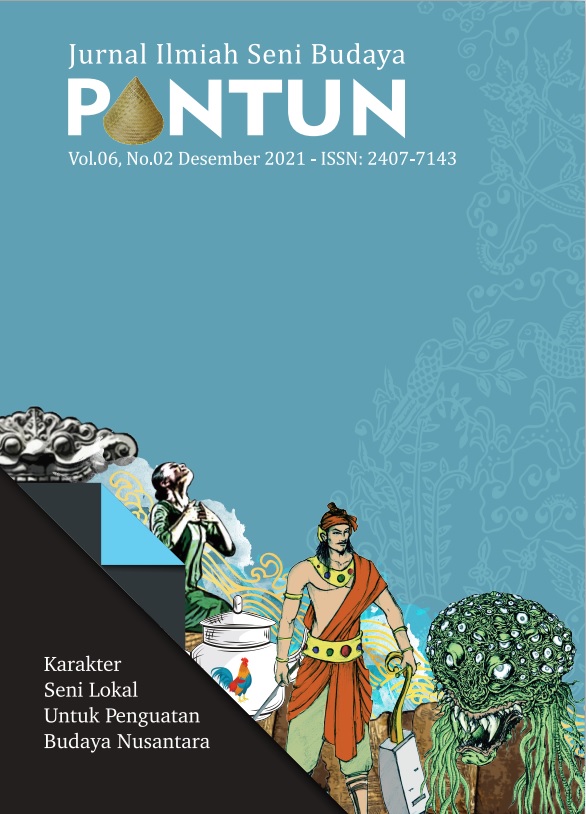
Visualisasi Desain Karakter Tokoh Utama dalam Lakon Wiracarita Batara Kamasara
DOI:
https://doi.org/10.26742/pantun.v6i2.1808Keywords:
Wangsakerta Manuscript, Hermeneutics, Epic, Visualization of Character Design.Abstract
The existence of the Wangsakerta Manuscript phenomenon is an indication and source of data to be followed up as ideas or ideas in writing (story script) and visual works. The story script or the play contains pseudo fiction with a colossal nuance typical of the archipelago which was inspired by a fragment of the Sargah I Parwa I Wangsakerta Manuscript about the Nirleka era in Tatar Parahyangan. The issues raised were the issue of the existence and power conflict between the stealth clan and the human clan which led to war. Moving on from this, the creation work is entitled “Wiracarita Batara Kamasara”. This story tells about the struggle and heroism of a young man named Kamasara in fighting tyranny and evil, beside the mission to restore his Kabuyutan honor which has been destroyed by the demon clan. Actualizing this invention is through a qualitative method including field observation and literature studies. Anthropologically, the theoretical study used in this study is hermeneutic conception promoted by Paul Ricoure regarding Metaphor. The result of the manuscript analysis is then applied to visualize the character designs of the storyline in this epic play.
Keywords: Wangsakerta Manuscript, Hermeneutics, Epic, Visualization of Character Design.
References
Ayatrohaedi. 2005. SUNDAKALA: Pustaka Rajya-rajya i Bhumi Nusantara, Pustaka Jaya, Jakarta.
Danasasmita, Saleh (Atja). 1987. Naskah Wangsakerta: Pustaka Pararatwan I Bhumi Jawadwipa, Depdikbud, Jakarta.
Hermawan, Deni & Dimyati, Ipit Saefidier. 2017. Antropologi Seni : Pendkatan, Teori, Metode dan Aplikasi, Pasca Sarjana ISBI, Bandung.
McCloud, Scott. 1993. UNDERSTANDING COMICS : The Invisible Art, Gramedia, Jakarta.
Nalan, Arthur. S, & Heriyawati, Yanti. 2016. Metode Penelitian Lapangan, Pasca Sarjana ISBI, Bandung.
Poespoprodjo. W. 2004. Hermeneutika Pustaka Setia, Bandung.
Soedarsono, R.M. 1999. Metodologi Penelitian Seni, Pertunjukan dan Seni Rupa, MSPI, Bandung.
Sumardjo, Jakob. 2003. Simbol-simbol Artefak Budaya Sunda: Tafsir-tafsir Pantun Sunda, Kelir, Bandung.
Sumardjo, Jakob. 2011. Sunda : Pola Rasionalitas Budaya, Kelir, Bandung.
http://www.fiksisejarah.org.com
Downloads
Published
How to Cite
Issue
Section
Citation Check
License
The Authors submitting a manuscript do so on the understanding that if accepted for publication, copyright of the article shall be assigned to Pantun: Jurnal Ilmiah Seni Budaya and Pascasarjana ISBI Bandung as the publisher of the journal. Copyright encompasses rights to reproduce and deliver the article in all form and media, including reprints, photographs, microfilms, and any other similar reproductions, as well as translations.
Pantun: Jurnal Ilmiah Seni Budaya and Pascasarjana ISBI Bandung and the Editors make every effort to ensure that no wrong or misleading data, opinions or statements be published in the journal. In any way, the contents of the articles and advertisements published in Pantun: Jurnal Ilmiah Seni Budaya are the sole and exclusive responsibility of their respective authors and advertisers.
The Copyright Transfer Form can be downloaded here: [……………..) The copyright form should be signed originally and send to the Editorial Office in the form of original mail, scanned document or fax :
Dr. Jaeni, S.Sn., M.Si. (Editor-in-Chief)
Editorial Office of Jurnal Pantun
Program Pascasarjana ISBI Bandung
Jl. Buah Batu 212 Bandung
Telp./fax +62-22-730532/+62-22-7303021
Email : jurnalpantun@isbi.ac.id