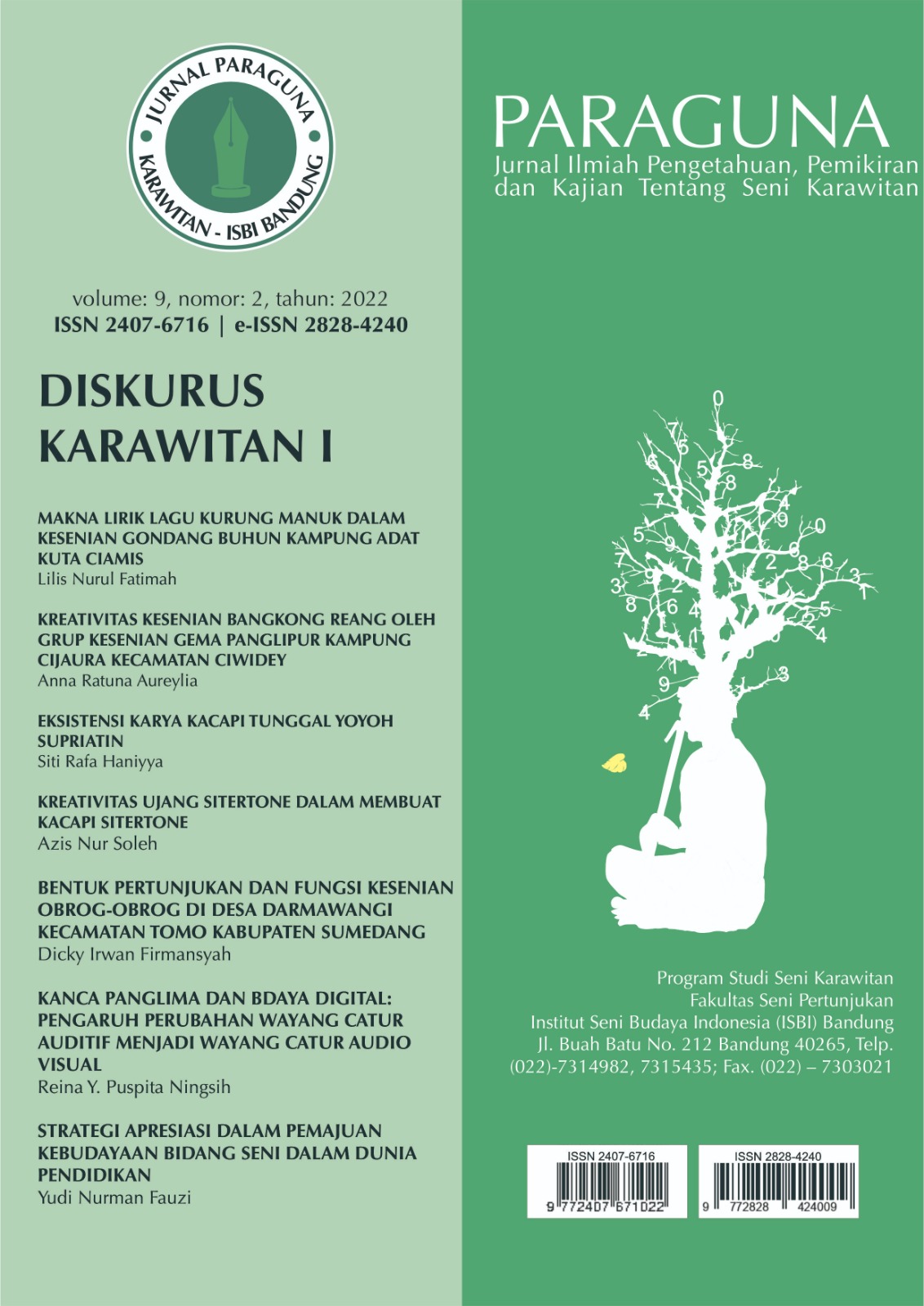
Bentuk Pertunjukan Dan Fungsi Kesenian Obrog-Obrog Di Desa Darmawangi Kecamatan Tomo Kabupaten Sumedang
DOI:
https://doi.org/10.26742/paraguna.v9i2.2235Abstract
This paper discusses the form and function of obrog-obrog art in Darmawangi Village, Tomo District, Sumedang Regency which is a typical art of the month of Ramadan. In practice, this art is highly anticipated by the community, because it plays an important role in the local community in deepening sahur and also other functions of entertainment, communication, movement response and cultural sustainability. The method used in this paper is a descriptive method with a paradigm approach based on the theory of performing arts by Hermin Kusmayanti, namely there are three phases of performing arts, namely form, meaning and function. In addition to the theory of performing arts, the theory of the function of music by Alan P. Merriam from his book entitled The Anthropology of Music is also used as a theoretical approach. The results of this study analyze the form of performance in the form of the structure and pattern of percussion of musical instruments and the function of obrog-obrog arts as a medium of entertainment, as communication, as a response to movement, and as cultural sustainability.
Downloads
Published
How to Cite
Issue
Section
Citation Check
License
- Authors retain copyright and grant the journal right of first publication with the work simultaneously licensed under a Creative Commons Attribution License that allows others to share the work with an acknowledgement of the work's authorship and initial publication in this journal. Authors are able to enter into separate, additional contractual arrangements for the non-exclusive distribution of the journal's published version of the work (e.g., post it to an institutional repository or publish it in a book), with an acknowledgement of its initial publication in this journal. Authors are permitted and encouraged to post their work online (e.g., in institutional repositories or on their website) prior to and during the submission process, as it can lead to productive exchanges, as well as earlier and greater citation of published work.