Transformasi dan Inovasi Kolotok Menjadi Alat Musik Bambu dalam Komposisi Kolotouch
The Transformation and Innovation of Kolotok into a Bamboo Musical Instrument in the Kolotouch Composition
Keywords:
Kolotok, Bamboo Music, Organological Innovation, Agrarian Culture, Musical Composition.Abstract
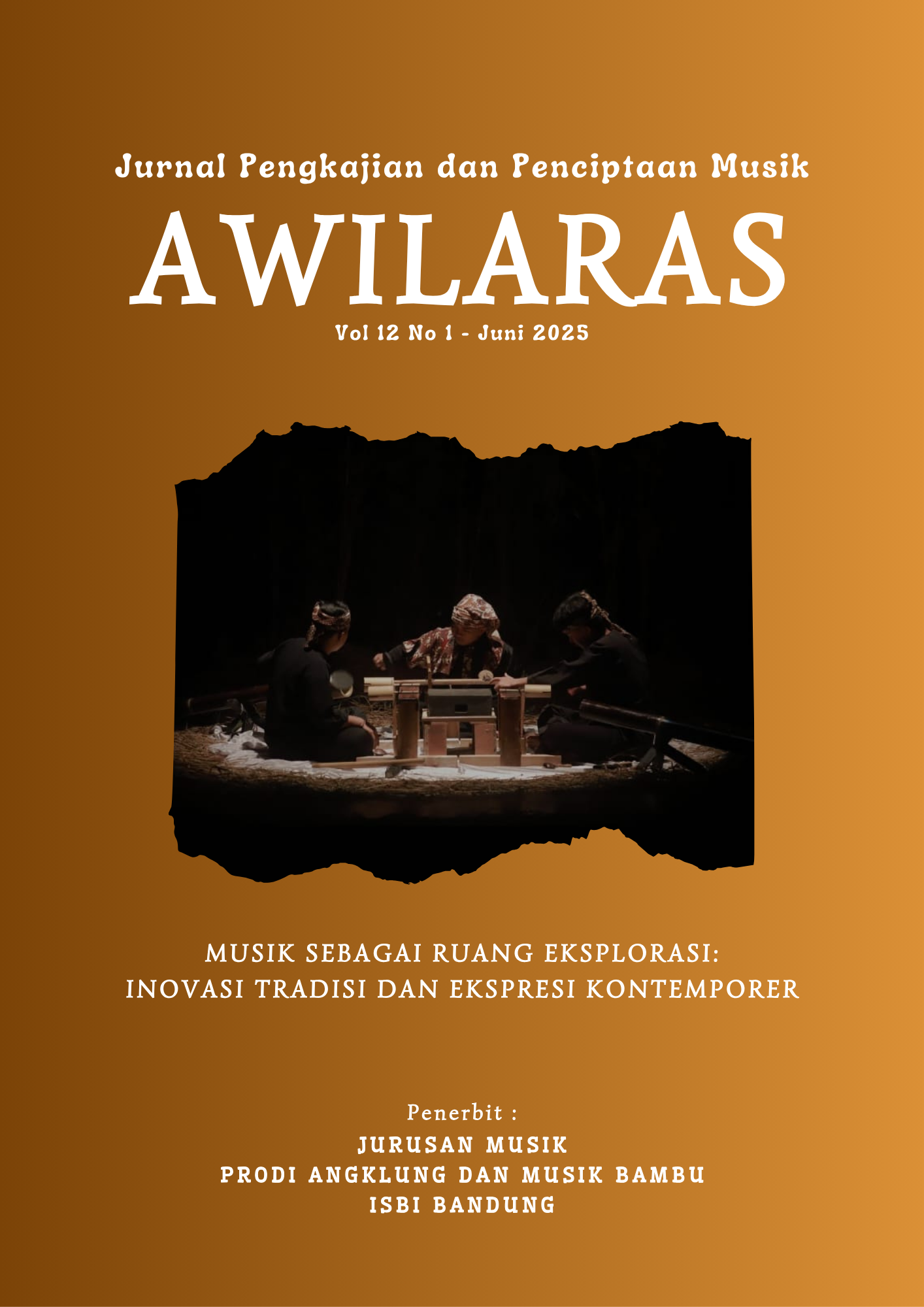
Kolotok, originally a livestock marker used in rice fields, has been increasingly marginalized due to modern technological advances that replace cattle and buffalo with mechanical plowing. The disappearance of its distinctive sound has not only silenced the dynamic atmosphere of the paddies but also eroded the agrarian cultural identity of the Ciamis community. This study aims to explore the transformation and innovation of kolotok into a new bamboo musical instrument through the composition “Kolotouch”. The method combines field observation, organological experimentation, acoustic measurement, and the application of Pande Made Sukerta’s text and context theory. The result is the Kolbam, a modified kolotok with a bamboo tube design that produces unique timbres according to the chamber size, integrated into modern bamboo music repertoire. This creation demonstrates that local instrument innovation can revive agrarian cultural values while enriching contemporary musical expression.
References
Blacking, J. (1973). How Musical is Man? Seattle: University of Washington Press.
Kartomi, Margaret J. (1990). On Concepts and Classifications of Musical Instruments.
Jaap Kunst. (1954). Music in Java: Its History, Its Theory and Its Technique
Merriam, A. P. (1964). The anthropology of music. Evanston, IL: Northwestern University Press.
Rosyadi, Dkk. 2014.Kajian Kearifan Lokal di Kampung Kuta Kabupaten Ciamis. Balai Plestarian Nilai Budaya Bandung. Cv.Izda Prima. Diakses 5 Maret 2024. http://repositori.kemdikbud.go.id.
Suharto. (2007). Akustik musik. Yogyakarta: Penerbit Andi.
Sukerta, Pande Made. (2011). Metode Penyusunan Karya Musik. ISI Press
Surakarta. Diakses 20 Februari 2024. http://repository.isi-ska.ac.id
Titon, Jeff Todd (2008). Worlds of Music: An Introduction to the Music of the World's Peoples.
Wallas, G. (1926). The Art of Thought. (Terjemahan). Diakses melalui https://archive.org/details/in.ernet.dli.2015.187209
Wasta, Asep. (2022). Perubahan Fungsi Kesenian Kolotik di Kecamatan Cimaragas Kabupaten Ciamis. Diakses pada 4 Oktober 2023. https://journal.umtas.ac.id.
Downloads
Published
Issue
Section
Citation Check
License
Copyright (c) 2025 Farhan Setiawan -, I Komang Kusuma Adi, Satria Mulya

This work is licensed under a Creative Commons Attribution 4.0 International License.
Acknowledgment This work was fully supported by funding…* Declarations Author contribution. All authors contributed equally to the main contributor to this paper. All authors read and approved the final paper. Funding statement.* This work was fully supported by funding... Conflict of interest. The authors declare no conflict of interest. Additional information. No additional information is available for this paper. * if available