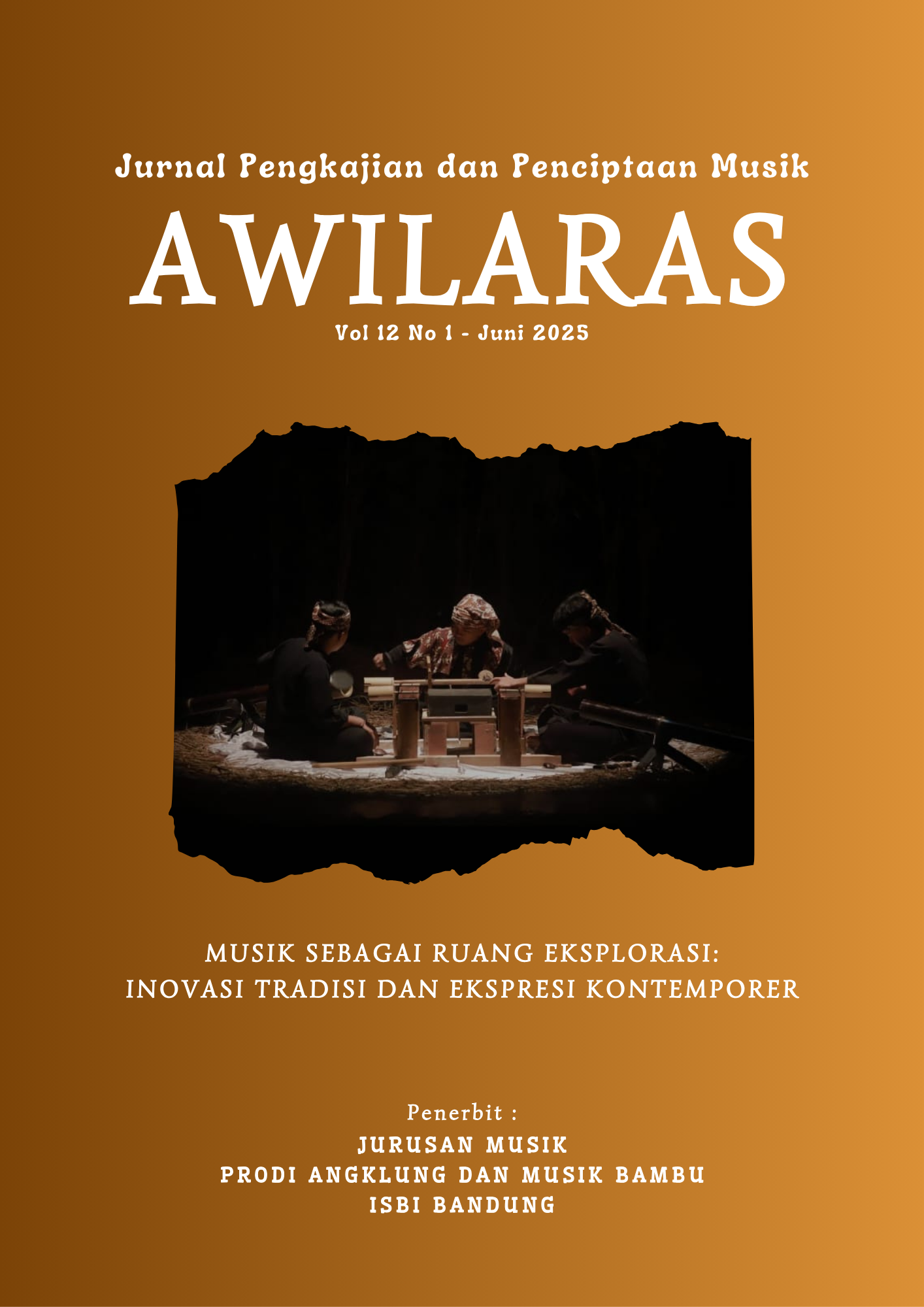
Analisis Teknik Permainan Gitar Elektrik Mateus Asato pada Lagu How Deep Is Your Love
Analysis of Mateus Asato's Electric Guitar Playing Technique on the Song How Deep Is Your Love
Keywords:
Gitar Elektrik, Mateus Asato, Teknik Permainan, Analisis Musik, How Deep Is Your LoveAbstract
The purpose of this study is to analyze the electric guitar techniques used by Mateus Asato in his version of How Deep Is Your Love. This research uses a qualitative descriptive method, with the researcher as the primary instrument, supported by tools such as an electric guitar, a laptop, Sibelius software, and YouTube. Data were collected through direct observation of Mateus Asato’s performance videos on YouTube and through document analysis, including scores and video recordings of his interpretation of the song.The results reveal that Mateus Asato uses a variety of distinctive electric guitar techniques, including hybrid picking, slide, bending, vibrato, legato, hammer-on and pull-off, chord melody, palm muting, and artificial harmonics, combined with expressive dynamics and articulation. These techniques contribute to a performance that is emotionally rich and musically nuanced, demonstrating a high level of technical skill and interpretative depth. The findings are expected to serve as a valuable reference for guitarists looking to expand their technical skills and deepen their understanding of artistic expression in song interpretation.
References
Banoe, Pono. 2003. Kamus Musik. Yogyakarta: Kanisius.
Brewster, David M. 2010. Guitar Tone: Pursuing the Ultimate Guitar Sound. Milwaukee: Hal Leonard Corporation.
Chen, L. (2015). The Role of Palm Muting in Modern Guitar Sound. Journal of Popular Music Studies, 27(3), 312–326.
Cohen, L., Manion, L., & Morrison, K. (2018). Research Methods in Education (8th ed.). Routledge.
Creswell, J. W., & Poth, C. N. (2018). Qualitative Inquiry and Research Design: Choosing Among Five Approaches (4th ed.). Sage.
Gambale, F. (2004). The Frank Gambale Technique Book. New York: Mel Bay Publications.
Govan, G. (2006). Creative Guitar: Advanced Techniques. San Francisco: Sanctuary Publishing
Harrison, A. K. (2021). Ethnography and Music: Methods for Understanding Musical Practice. Journal of Qualitative Research, 22(1), 45–62. https://doi.org/10.1177/1468794121990956
HAERUDDDIN, H. (2018). Proses Pembuatan Gitar Akustik Produksi Harmoni Gitar Makassar (Tinjauan Organologi).
Hidayatullah, A. F. 2024. Analisis Teknik dan Sajian Lagu Maria Karya Mateus Asato. Repertoar Journal Universitas Negeri Surabaya, 1(5).
Indrawan, A. (2019). Mengenal Dunia Gitar Klasik. Mengenal Dunia Gitar Klasik, 1– 10. Retrieved from http://digilib.isi.ac.id/5238/1/MengenalDuniaGitarKlasik_New Edition 2019.pdf
Jamalus, 1988. Musik Untuk PSG. Jakarta: Depdikbud.
Johnson, P. (2017). Integrating Melody and Harmony in Solo Guitar Performance. Journal of Jazz Studies, 14(2), 77–89.
Marandika, M. A., Epria, I., Putra, D., & Pd, M. (2024). Ekstrakurikuler Gitar Elektrik Di SMA Negeri 2 Kota Bengkulu Electric Guitar Extracurricular at SMA Negeri 2 Bengkulu City, 2, 133–146.
Permadi, I. 2015. Analisis Teknik Permainan Gitar Klasik Sonate Mozart KV 331 (300i) Movement Alla Turca, 331, 100.
Patton, M. Q. (2015). Qualitative Research & Evaluation Methods (4th ed.). Sage.
Silverman, D. (2020). Interpreting Qualitative Data (6th ed.). Sage.
Stetina, T. (2002). Lead Guitar Techniques. Milwaukee: Hal Leonard.
Wicaksono, Herwin Yogo. 1998. Ilmu Bentuk Analisis Dasar. Yogyakarta: Institut Keguruan dan Ilmu Pendidikan Yogyakarta.
Zebua, C. G. 2019. Penerapan Teknik Permainan Gitar Elektrik Glassgow Kiss Karya John Petrucci Pada Lagu Lebih Dari Pemenang. Areopagus : Jurnal Pendidikan Dan Teologi Kristen, 17(2), 34–54.
Zuniaric Wahyu Aldiansyah. (2016). Analisis Teknik Permainan Gitar Elektrik pada Lagu Always With Me Always With You Karya Joseph Joe Satriani, 5(1), 1–23.
Downloads
Published
Issue
Section
Citation Check
License
Copyright (c) 2025 Farid Yoelhian Nasution, Irdhan Epria Dharma Putra

This work is licensed under a Creative Commons Attribution 4.0 International License.
Acknowledgment This work was fully supported by funding…* Declarations Author contribution. All authors contributed equally to the main contributor to this paper. All authors read and approved the final paper. Funding statement.* This work was fully supported by funding... Conflict of interest. The authors declare no conflict of interest. Additional information. No additional information is available for this paper. * if available